Why this mattered
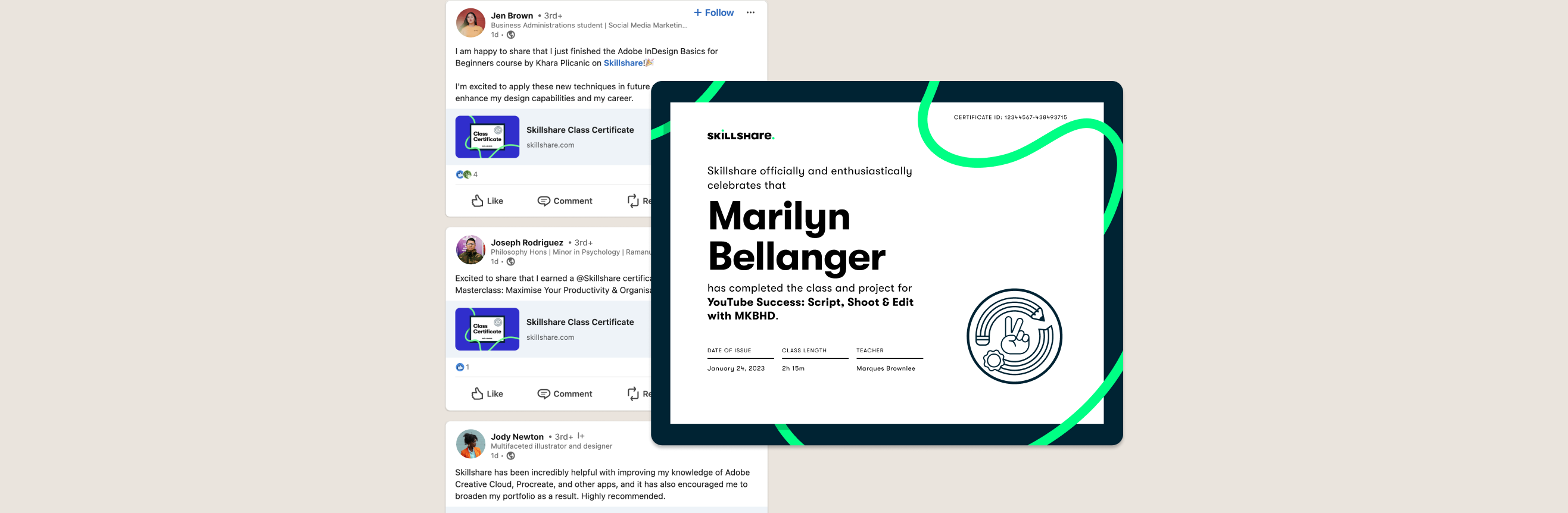
Retention was the real problem. A significant share of members went dormant during their free trial and again after converting to paid, and the company needed a reward mechanism that could change that trajectory. Certificates also carried a second business case: every certificate shared outside Skillshare was a small, organic acquisition channel.
Badges had already proven the technical foundation could support gamification. What hadn't been proven was whether a reward could move the metric that actually mattered: class completion and project submission, the moments where members did the deepest work and got the least recognition for it.
The user problem
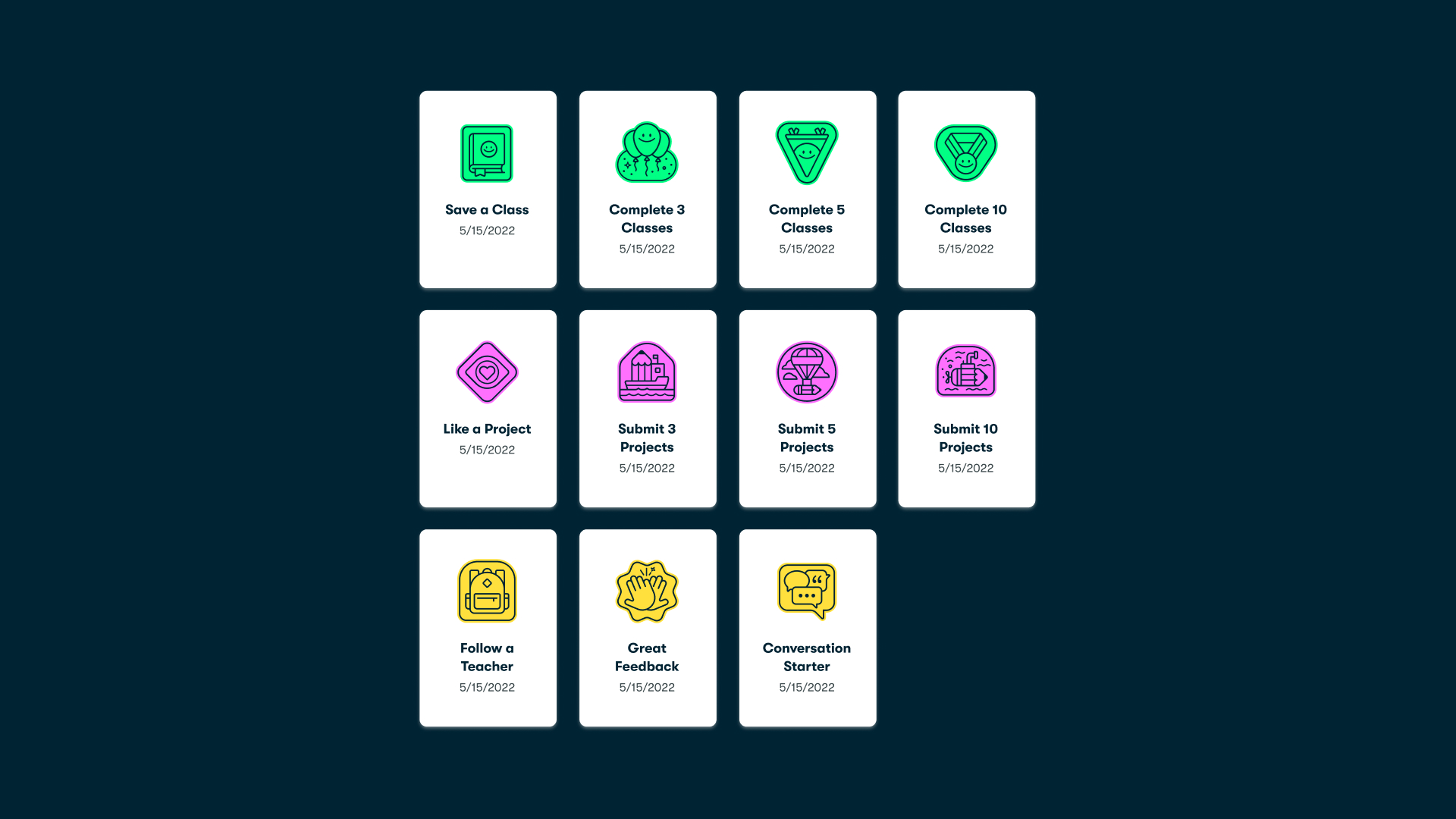
Badges rewarded breadth. Watching a lesson, saving a class, following a teacher, all counted. None of it pushed members toward finishing a class or submitting a project, which meant the feature that was supposed to deepen engagement was reinforcing shallow behavior instead.
Finding the right behavior to reward
The open question inside the team was simple to ask and hard to answer: what's the moment worth celebrating? Completing a class? A learning path? Submitting a project?
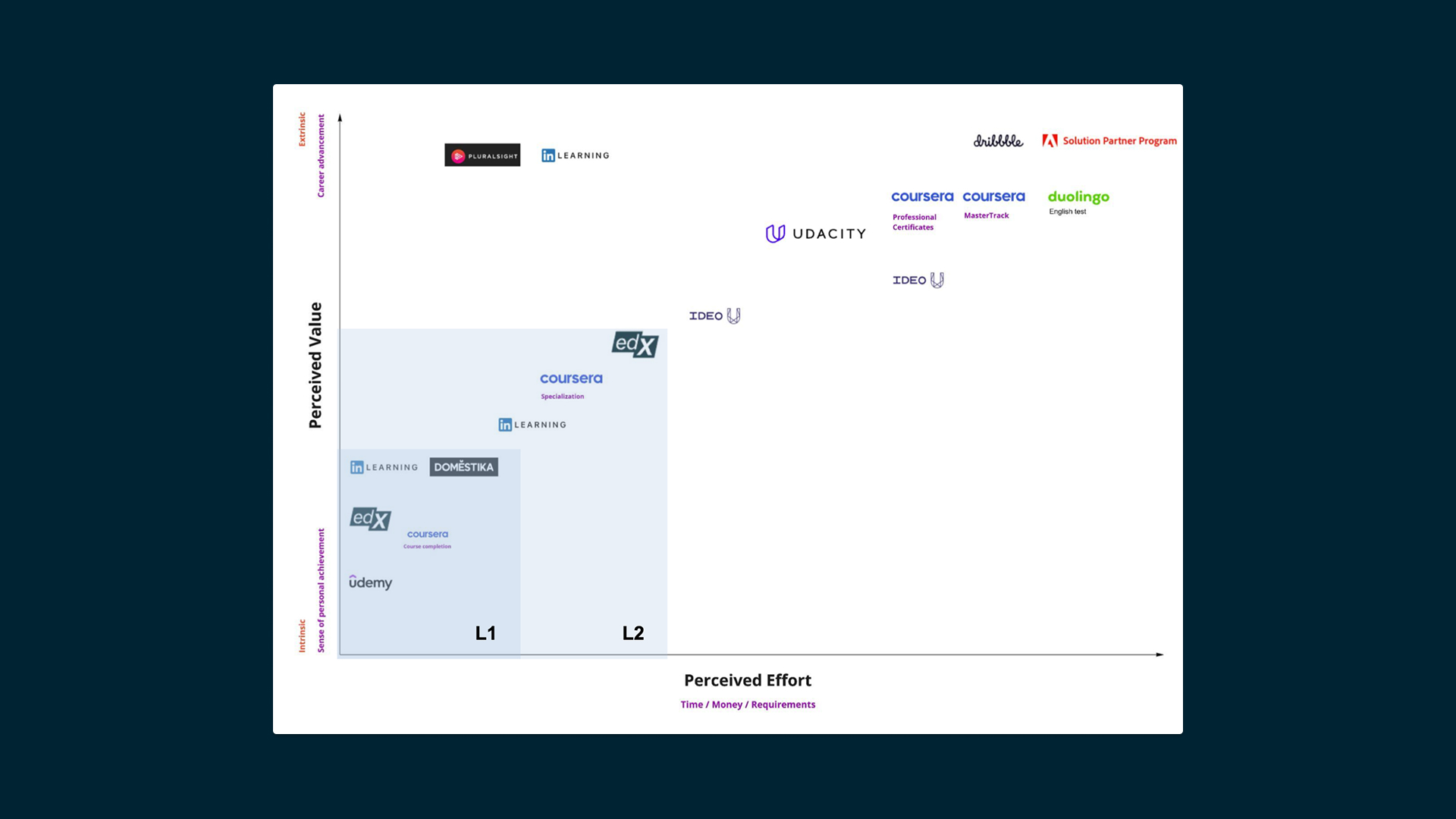
I ran a competitive audit across 11 platforms to see how certificates were positioned elsewhere, mapping perceived value against required effort. The pattern was consistent: certificates that felt meaningful required more from the user, usually a graded assignment.
Social listening settled the debate. Members weren't organically sharing course completions. They were sharing project outcomes, the tangible proof of a skill they'd just built. That told us where the value actually lived.
I built a decision framework around three lenses: does this behavior drive user value, does it drive business growth, and do enough members actually do it. That framework became the case for leadership to align on Skillshare's first certificate criteria: complete a class and submit a project.
Three key decisions
Contextual hooks and accurate progress tracking
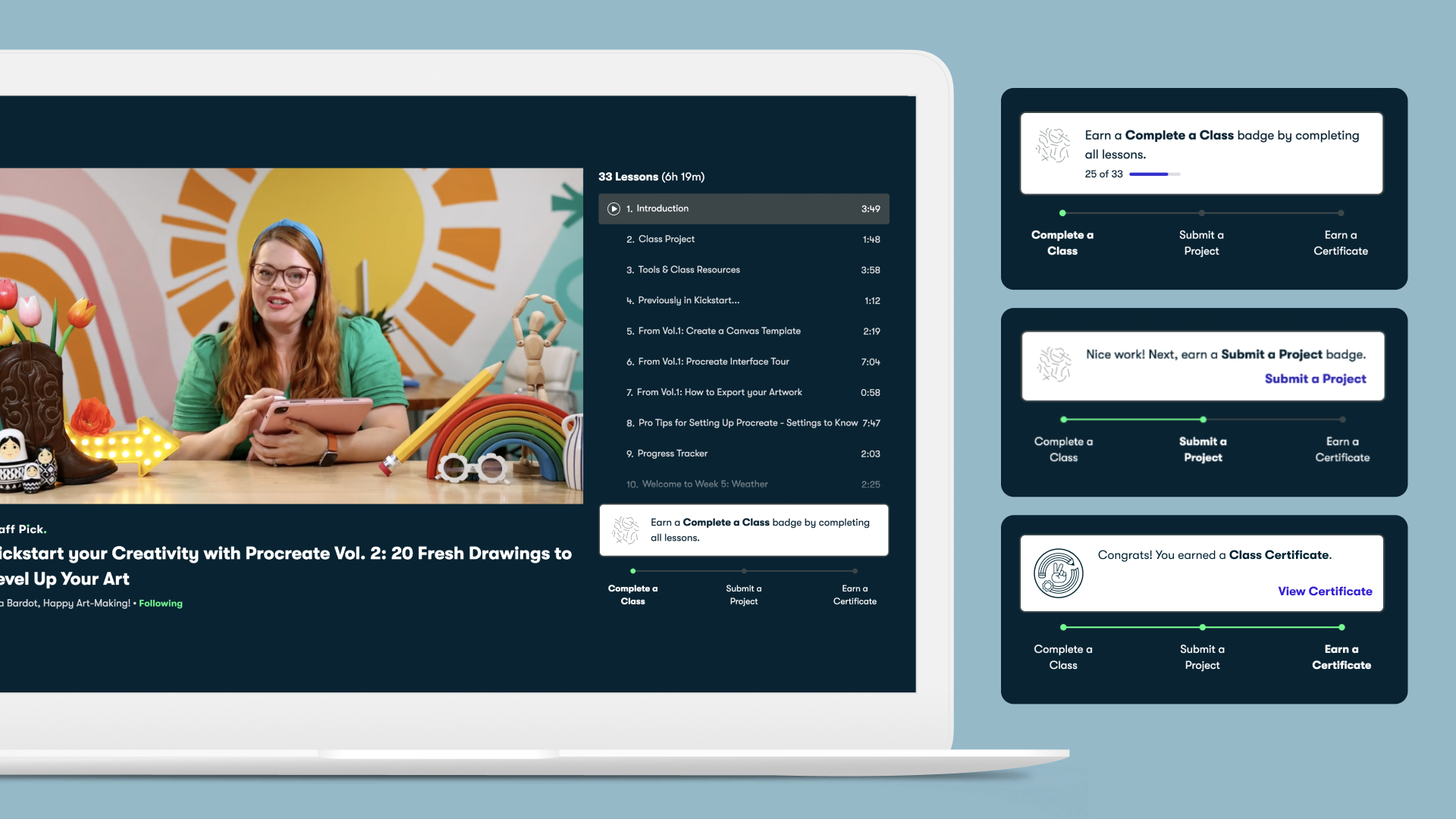
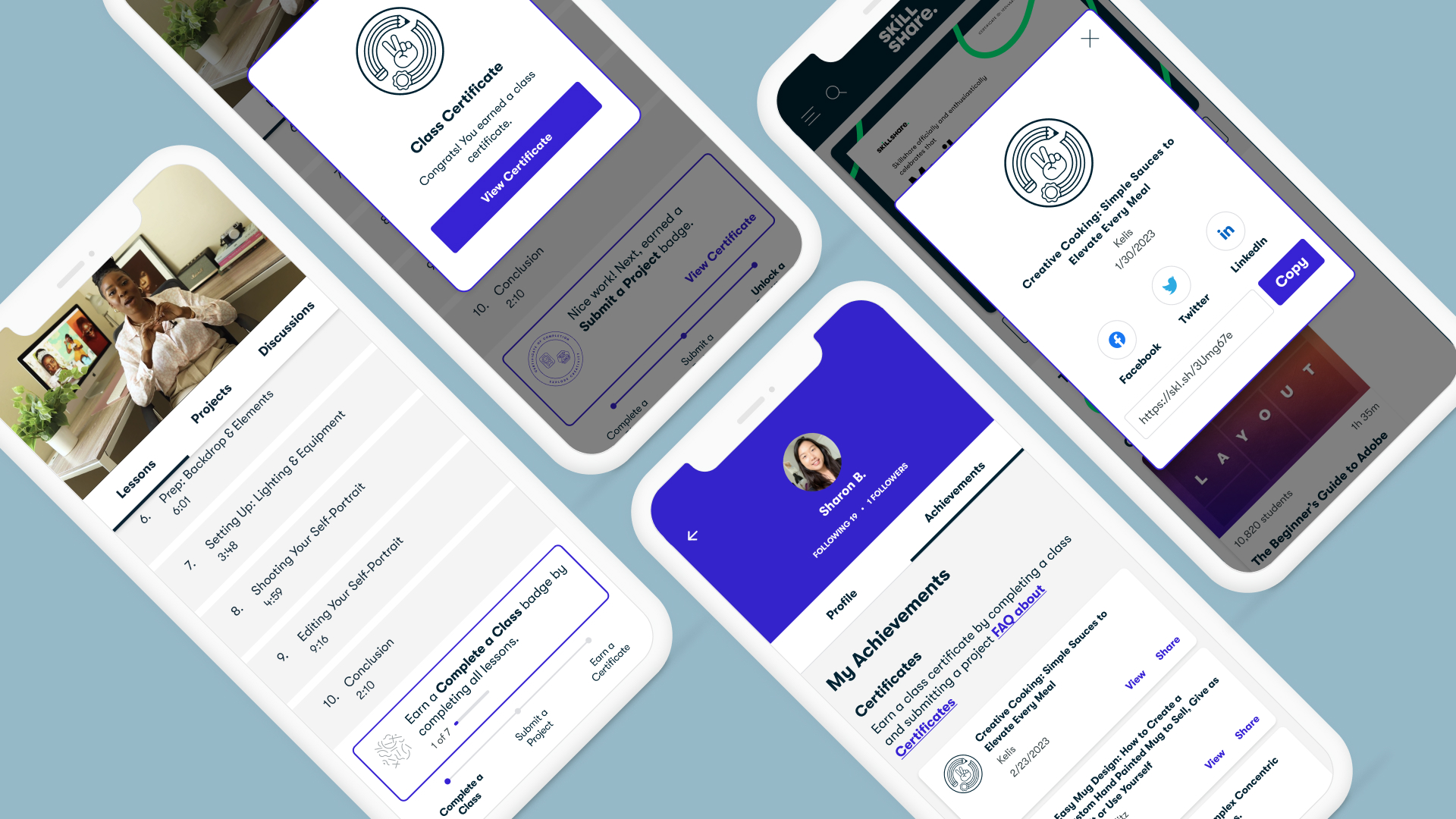
The progress module lived at the end of the lesson plan, so members could see exactly what stood between them and a certificate: remaining lessons, then a project. I also had to reconcile new and legacy progress signals (organic watching vs. scrubbing the video bar) so members never wondered whether an action counted.
Celebration, tuned by platform
A single completion moment could trigger multiple rewards at once, something the badge system had never fully solved. Mobile could support a bigger, more immersive celebration since dismissing a notification is low-friction there. Web called for restraint: stacked toasts that resolved on their own after 8 seconds. I prototyped the sequencing myself so engineering could see the timing, not just describe it.
A share flow that pulls new users in
Sharing a certificate needed to work cleanly across the platforms members actually use. When someone new clicked a shared certificate, they'd see the class and the project behind it, turning one member's achievement into another member's entry point.
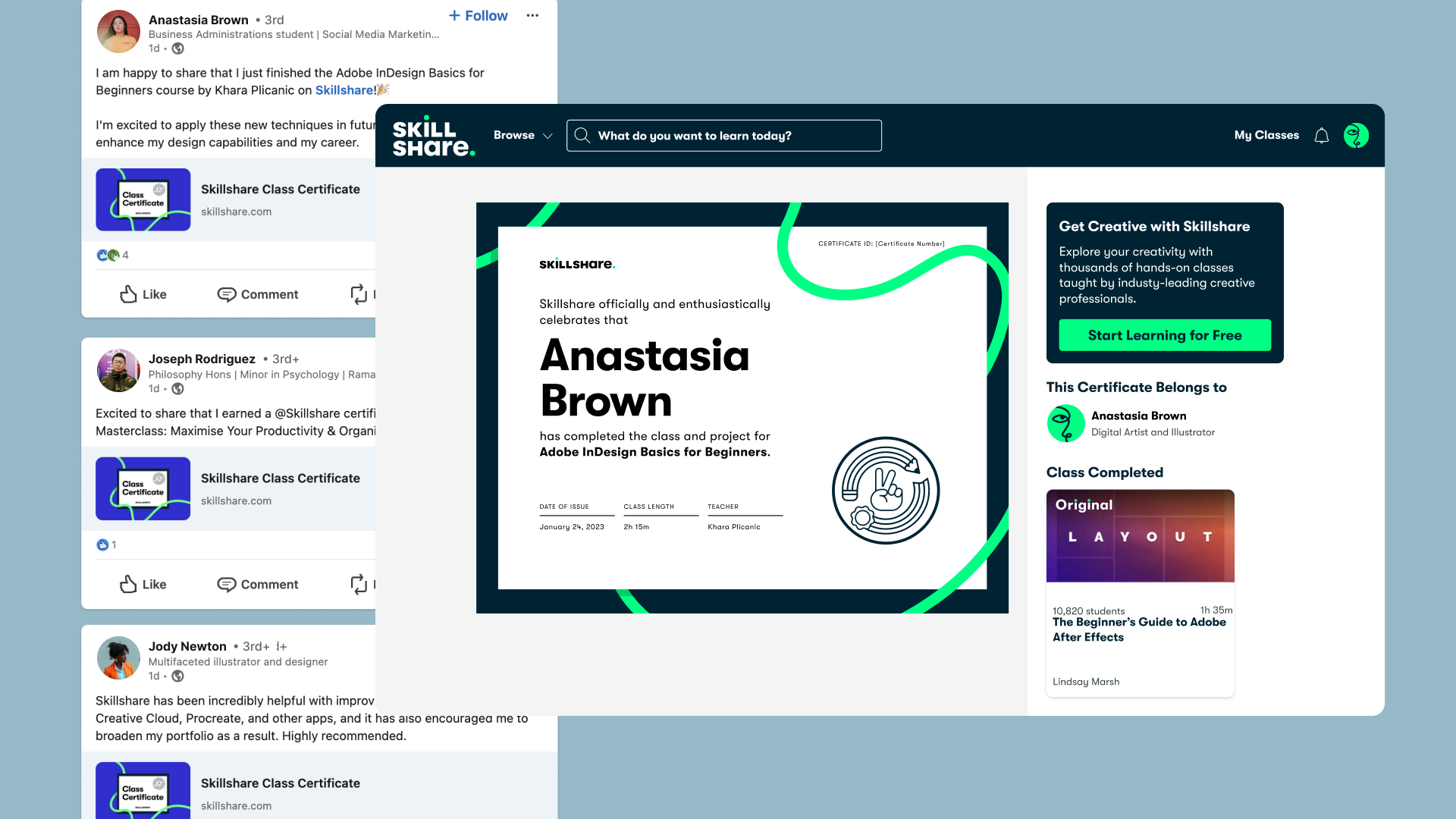
Working with brand and engineering
I wrote the creative brief for the certificate illustrations and brought back Kevin Moran, the teacher who'd designed the original badges, to keep the visual language consistent. I handed off specs and mockups, flagged internationalization and technical constraints, and left the aesthetic judgment to the brand team.
This shipped across web, mobile web, iOS, and Android at once, each with different reward mechanics and a legacy alert system to avoid colliding with. I shared designs early and kept visual references current so engineering wasn't surprised in QA.
Outcome
Certificates awarded in the first half post-launch
Of members who earned a certificate shared it outside Skillshare
Lift in project submission
What I took from this
The instinct going in was to design around what the business wanted to showcase. What actually worked was designing around what members already valued and letting the business outcome follow. Elevating project submissions also surfaced problems nobody had prioritized before, privacy concerns, incomplete submissions, that we then had to solve for both students and teachers. The engagement lift was the visible result. The quieter win was fixing parts of the product that had been overlooked for years.
Skills & Methods